

Stronger Threads, Smoother Fabrics: The Science Behind Textile Starch

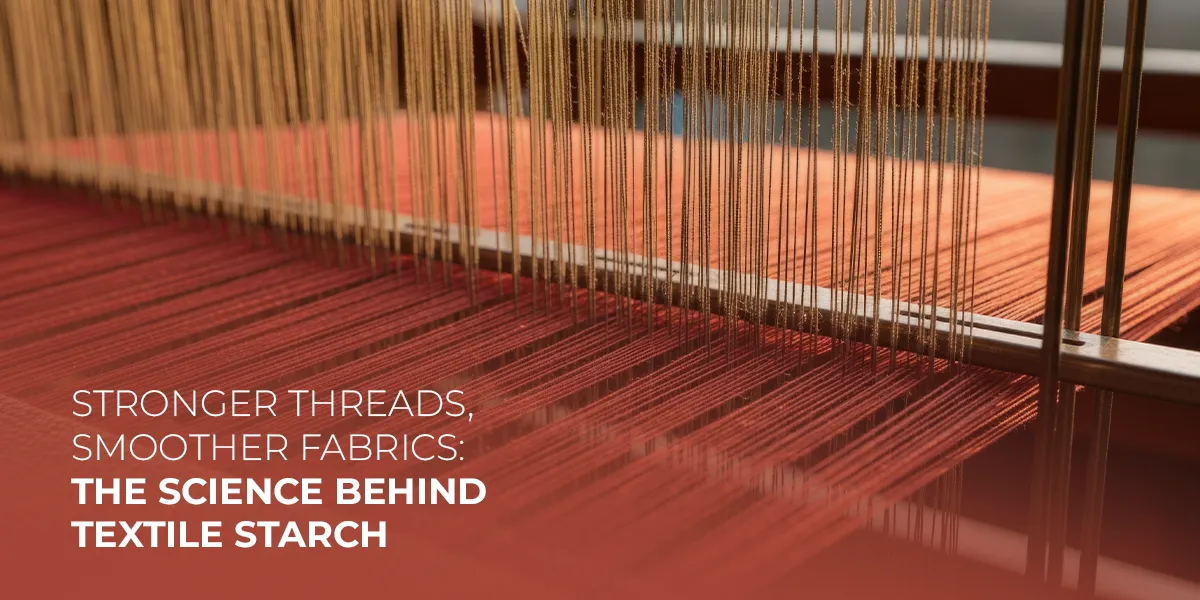
Textile processing involves multiple stages where yarn and fabric are subjected to mechanical stress, friction, and high-speed operations. During weaving, warp yarns must withstand continuous tension and abrasion as they pass through looms. In this environment, untreated yarn can break, leading to production interruptions and variation in fabric quality.
To address this, Textile Starch is introduced during the sizing stage as a process material that supports yarn integrity and weaving efficiency.
Role of Textile Starch in Textile Processing
Textile Starch is applied to warp yarns in the form of a sizing solution. The starch forms a thin, continuous film over the yarn surface. This coating modifies the physical behaviour of the yarn during weaving without altering its core structure.
The presence of starch contributes to:
- Increased yarn strength during tension cycles
- Reduced surface hairiness
- Lower friction between yarn and machine components
- Improved resistance to abrasion
These characteristics support stable loom performance and consistent fabric formation.
Functional Properties of Textile Grade Starch
Textile grade starch is selected and processed based on its functional behaviour under textile operating conditions. The following properties define its performance:
- Film Formation: Starch molecules create a uniform coating around yarn fibres. This film acts as a protective layer during high-speed weaving.
- Adhesion to Fibre Surface: The starch solution adheres effectively to natural and synthetic fibres, ensuring uniform coverage and stability during processing.
- Viscosity Control: Controlled viscosity enables even application across yarn lengths. It also supports penetration into fibre interstices where required.
- Flexibility of Coating: The formed film maintains sufficient flexibility to prevent cracking or flaking under mechanical stress.
- Desizing Compatibility: After weaving, the starch layer can be removed through standard desizing processes without affecting the base fabric.
Application in Textile Manufacturing
Textile Starch is primarily used in warp sizing operations. Its application extends across multiple textile segments:
- Cotton yarn processing for improved weaving performance
- Blended yarn systems where uniform coating is required
- Synthetic fibre applications with controlled adhesion characteristics
- High-speed loom operations where abrasion resistance is critical
In each case, the starch functions as a process aid that stabilises yarn behaviour under production conditions.
Role of Modified Starch in Textile Processing
In addition to native starch, Modified Starch in India is used in textile applications where specific functional adjustments are required. Modification alters certain physical or chemical characteristics of starch to match processing conditions.
Modified starch variants in textile use may exhibit:
- Enhanced viscosity stability under temperature variation
- Improved resistance to mechanical shear during application
- Controlled penetration into the yarn structure
- Consistent film strength across different fibre types
These characteristics support uniform sizing performance, especially in large-scale textile operations.
Manufacturing and Specification Aspects
Production of textile grade starch involves controlled processing of starch sources to achieve the required performance parameters. Key aspects include:
- Particle size control to ensure smooth dispersion in sizing solutions
- Moisture regulation for storage stability and handling
- Viscosity standardisation based on textile process requirements
- Purity levels aligned with industrial textile usage
A Textile Starch Manufacturer in India typically supplies starch in forms suitable for direct integration into sizing formulations. Variations may be developed to match specific yarn types, loom speeds, and processing conditions.
Industrial Usage and Process Integration
Within textile units, starch is incorporated into sizing formulations along with other process agents. The prepared solution is applied through sizing machines, where yarn passes through the starch bath and is subsequently dried under controlled conditions.
The outcome of this process includes:
- Improved yarn cohesion
- Reduced breakage rates during weaving
- Smoother fabric surface after loom processing
- Consistent fabric structure across production batches
The role of starch remains confined to process support, with removal carried out during desizing before further finishing operations.
Conclusion
Textile Starch functions as a critical process material in textile manufacturing, particularly in warp sizing. Its role is defined by film formation, adhesion, and mechanical support during weaving.
Both native and modified starch in India are utilised based on processing requirements, with textile grade starch tailored to deliver consistent behaviour under industrial conditions.
The application of starch in textile systems remains focused on improving yarn performance, ensuring operational continuity, and maintaining fabric uniformity across production cycles.
Contact Bluecraft Agro
For product specifications and application-related details:
Email: marketing@bluecraftagro.com
Call: 02717 454547
Contact Page: https://bluecraftagro.com/contact-us