
Understanding the Difference Between Native and Modified Starches

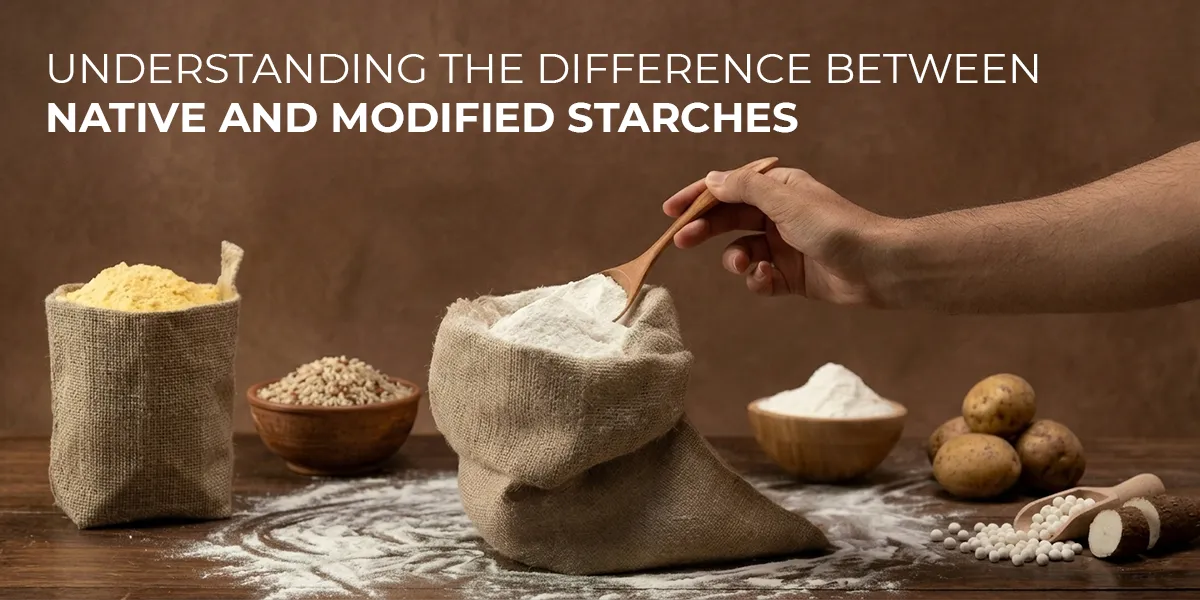
Starch is a carbohydrate derived from plant sources such as maize, rice, potato, wheat, and tapioca. It is used as a functional ingredient in food processing, pharmaceutical formulations, and industrial applications such as paper, textiles, and adhesives.
Starches can be used in native or modified forms based on application requirements and end-product formulations. Native starch is obtained directly from plant sources without altering its structure, while modified starch is processed to adjust its functional properties for specific manufacturing conditions.
In food and pharmaceutical applications, starch is used in formulations intended for human consumption. In contrast, industrial applications such as paper processing, textile sizing, and adhesives involve starch as a functional material in non-ingestion systems. The selection of starch type depends on processing conditions and the functional role required in the application.
Native Starch: Composition and Characteristics
Native starch refers to starch extracted from plant sources without chemical or enzymatic modification. The granule structure remains intact during production, retaining its natural composition of amylose and amylopectin.
One commonly used example is native maize starch, produced through the wet milling of maize. This process separates starch from protein, fiber, and germ components, resulting in a refined starch powder suitable for industrial and food applications.
Native starch demonstrates several functional properties:
- Thickening when heated in water
- Film formation during drying
- Binding capability in dry and semi-solid systems
- Gel formation under controlled conditions
In food processing, native starch contributes to viscosity development and texture formation in products such as sauces, soups, bakery fillings, and dairy formulations. In the pharmaceutical industry, native starch is used as an excipient and acts as a binder, emulsifier, and disintegrant for tablets, syrups, supplements, and more.
In industrial applications, native starch is used in textile sizing to improve yarn strength during weaving. In paper manufacturing, it is used in surface sizing to enhance paper strength and surface characteristics. In adhesive systems, starch acts as a binder in corrugation and packaging applications.
Modified Starch: Processing and Functional Role
Modified starch is produced by subjecting native starch to physical, chemical, or enzymatic treatments that alter its functional behaviour. These modifications are designed to meet specific performance requirements in industrial processing environments.
Modification processes adjust properties such as viscosity stability, resistance to mechanical shear, and performance under varying temperature and pH conditions.
Modified starch performs several functional roles in manufacturing systems:
- Maintaining viscosity under thermal and mechanical stress
- Improving stability in processing systems
- Supporting consistent dispersion in liquid formulations
- Enhancing binding and film-forming characteristics
In food processing, modified starch is used in applications where processing conditions require controlled stability, such as in certain processed foods, dairy systems, and frozen products.
In industrial applications, modified starch is widely used in paper manufacturing as a binder in coating and surface sizing processes. It is also used in textile finishing and in adhesive formulations where consistent performance during processing is required.
Manufacturers sourcing modified starch in India obtain these materials from starch processing companies and established modified starch supplier networks that produce starch derivatives developed for specific industrial processing and formulation requirements.
Functional Differences Between Native and Modified Starch
The primary difference between native and modified starch lies in their behaviour during processing.
Native starch retains its original granule structure and performs effectively in applications where processing conditions are moderate. It provides thickening, gel formation, and binding properties in various formulations.
Modified starch is designed to maintain functional performance under more demanding processing conditions, including high temperature, mechanical shear, and variations in processing environments. Structural modification enables consistent performance where native starch functionality may be limited.
Both forms are used based on the processing environment and application requirements.
Industrial Supply and Manufacturing Capabilities
Industrial starch production involves raw material processing, milling, separation, purification, and drying to ensure consistent product quality.
Starch manufacturers produce native starch from agricultural sources such as maize and supply it to food processors, textile units, paper mills, and adhesive manufacturers.
Modified starch production involves additional processing stages to tailor starch properties for specific industrial uses, particularly in paper and textile manufacturing systems.
Bluecraft Agro manufactures native starch for food processing, pharma, and other industrial applications and produces modified starch for industrial sectors, including paper and textiles. These products are supplied to support application-specific requirements across different manufacturing environments.
Conclusion
Native starch and modified starch differ in their processing methods and functional performance. Native starch retains its natural structure and provides thickening, binding, and film-forming properties in both food and industrial applications.
Modified starch is processed to adjust its performance under specific manufacturing conditions, particularly in industrial applications such as paper processing, textiles, and adhesives.
Both forms of starch are used across manufacturing sectors depending on formulation requirements and processing conditions.
For product information, industrial supply inquiries, or application support related to starch ingredients, contact Bluecraft Agro:
Email: marketing@bluecraftagro.com
Call: 02717 454547
Contact Page: https://bluecraftagro.com/contact-us