
Why Non-GMO Corn Is Preferred by Buyers: Benefits and Market Opportunities

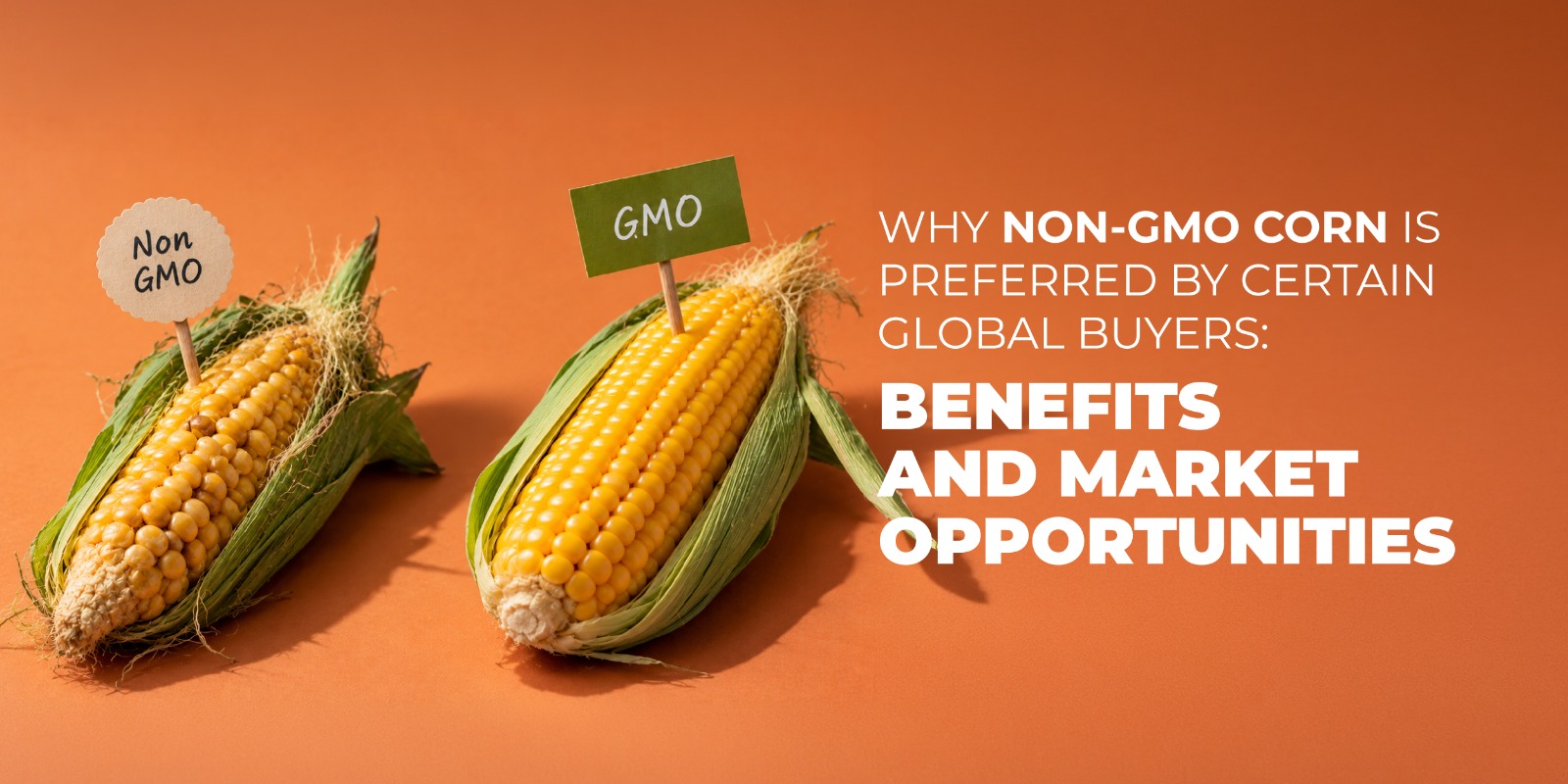
Corn moves through several global supply chains, from direct food processing to starch production and other manufacturing applications. Within these markets, non-GMO (non-genetically modified organism) corn represents a distinct sourcing category. Its relevance is particularly visible among buyers whose product specifications, labelling requirements, customer commitments or destination-market regulations require documented control over genetically modified material.
The preference for non-GMO corn is therefore not universal, nor does the term indicate that genetically modified corn is inherently unsafe. In the European Union, authorised genetically modified maize undergoes safety assessment before approval for food and feed use. The commercial distinction arises largely from regulatory frameworks, labelling requirements, and individual market specifications.
What Does Non-GMO Corn Mean in the Supply Chain?
Non-GMO corn generally refers to corn produced from seed varieties that have not been genetically engineered. For manufacturers purchasing corn or corn-derived ingredients, however, the specification involves more than the seed itself.
Identity preservation can extend through procurement, storage, transportation, processing and documentation. This helps maintain separation from genetically modified material and provides traceability through different stages of the supply chain.
For buyers serving markets with defined non-GMO requirements, this traceable chain can form part of the raw material specification.
Why Certain Global Buyers Specify Non-GMO Corn
1. Compliance Benefits for Destination-Market Requirements
Regulatory conditions differ considerably between countries.
The European Union, for example, maintains specific traceability and labelling requirements for genetically modified food and feed. Under current EU rules, GM food and feed generally require appropriate identification, while an exemption applies where authorised GM presence does not exceed 0.9% of an individual ingredient and that presence is adventitious or technically unavoidable.
For exporters and ingredient manufacturers supplying such markets, the GMO status of corn can therefore affect sourcing, documentation, and segregation practices.
2. Benefits of Meeting Customer Product Specifications
Regulation is only one reason for non-GMO procurement. Individual manufacturers, retailers, and brand owners may establish their own ingredient specifications according to the products and markets they serve.
A corn processor may consequently require non-GMO raw material because the finished ingredient is destined for a customer with a defined non-GMO specification.
This creates demand throughout the upstream supply chain, including corn processors and manufacturers of corn-derived ingredients.
3. Traceability Benefits Across the Supply Chain
Traceability has become an established component of international food supply chains.
For example, EU food regulations require businesses to maintain information that allows ingredients and products to be traced through production, processing, and distribution. GMO-specific EU rules introduce additional traceability obligations for products within their scope.
For non-GMO corn supply chains, documentation, lot identification, and controlled material movement help buyers verify whether supplied material corresponds with their procurement specification.
Non-GMO Corn and Starch Manufacturing
Corn is an important raw material for starch production. During wet milling, different components of the kernel are separated, allowing starch to be recovered and processed according to the required application.
Where customers specify non-GMO corn-derived starch, raw material sourcing becomes part of the finished product’s specification framework.
The relevant controls can include:
- Defined corn sourcing requirements
- Supplier and batch documentation
- Segregation during storage and material handling
- Traceability through processing
- Testing or certification where required by the customer or destination market
These controls are particularly relevant to food industry customers working with established non-GMO sourcing programmes.
Market Opportunities are Specification-Driven
The commercial opportunity for non-GMO corn is best understood as a segmented market requirement, rather than a replacement for conventional global corn trade.
International corn markets remain substantial and diverse. Buyers source according to price, availability, quality parameters, regulatory approval and end-use requirements. Data from the United States Department of Agriculture (USDA), for example, show continued corn trade with markets across Asia, Europe and the Americas, illustrating the breadth of global demand and the differences between destination markets.
Within this larger market, non-GMO corn creates specific opportunities for suppliers capable of meeting defined identity, traceability, and documentation requirements.
For starch manufacturers, this can translate into demand for corn-derived ingredients manufactured from documented non-GMO raw material, particularly where downstream customers have incorporated GMO status into procurement specifications.
The Importance of Specification Control
For global buyers, non-GMO status is only one part of corn procurement. Quality parameters remain central to manufacturing performance.
Depending on the intended application, procurement specifications may address moisture, foreign matter, physical condition, microbiological parameters, and other quality characteristics alongside GMO status.
The same principle applies when corn is processed into starch. Manufacturers evaluate the finished starch according to application-specific characteristics and quality parameters, while non-GMO origin may form an additional requirement for designated customers.
Bluecraft Agro and Corn-Based Manufacturing
For Bluecraft Agro, corn serves as a primary raw material for starch and starch-based products supplied to different customer industry segments. Raw material selection, processing controls, and specification management influence the consistency of the resulting starch products.
Where non-GMO requirements apply, clear sourcing specifications and traceability provide the foundation for supplying customers whose markets or internal procurement programmes require documented non-GMO corn-derived ingredients.
Conclusion
Non-GMO corn occupies a specific position within global agricultural and ingredient supply chains. Its preference among certain buyers is driven by destination-market regulations, labelling frameworks, customer specifications, and traceability requirements rather than a universal distinction in corn quality.
As international manufacturers operate across increasingly differentiated markets, the opportunity for non-GMO corn lies in maintaining clear specifications, controlled sourcing and verifiable traceability from raw material procurement through processing.